About five minutes each, on real Swiftedge market data. No signals and no promises: you learn to read what the market is doing.
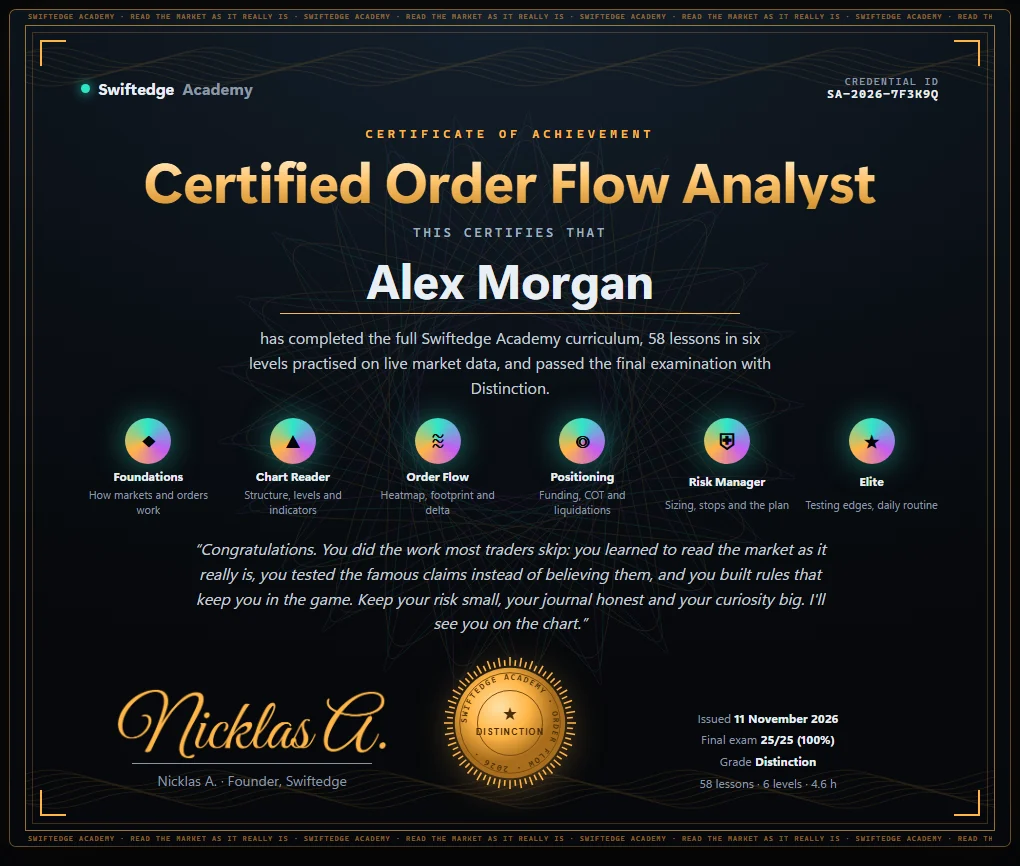
Finish all six levels and pass the final exam: 25 new questions on theory, real charts and calculations. 80% passes, 22 earns Merit, 24 earns Distinction.
Your certificate carries your name, your grade, a credential ID and the founder's signature, and you can add it to LinkedIn in one click.
Level 1, with 9 lessons, is free for everyone. Levels 2 to 6, the final exam and the certificate are part of Swiftedge Plus. The Swiftedge tools themselves stay free.
Each lesson takes about five minutes. All 58 lessons take around 4.6 hours, at your own pace.
No. Level 1 starts with what a price is and how an order meets the order book. Each level builds on the one before.
Yes. Every chart, simulation and image is made from real Swiftedge market data: Bitcoin, Ethereum, gold, silver, oil and US indices.
No. The school teaches you to read the market and to test ideas honestly. Where a popular method failed our own tests, the lesson says so.
Each lesson takes about 5 minutes: a hook, the idea, a hands-on simulation, the live view on Swiftedge, and a quiz worth XP.
How markets work, before you read a single chart.
Simulation: Replay a real Bitcoin afternoon
1.2Simulation: Long or short? 5 rounds of real Bitcoin
1.3Simulation: Spin the 24-hour clock
1.4Simulation: Fire a market buy into the real book
1.5Simulation: Stress the spread
1.6Simulation: Pick your leverage, then replay
1.7Simulation: Switch on all four lenses
1.8Simulation: Morph a real gold session
1.9Simulation: Red flag or fine?
The classic tools, tested honestly on real Swiftedge data.
Simulation: Find the levels gold respected
2.2Simulation: Draw a trend line on real Bitcoin
2.3Simulation: Round numbers vs random levels
2.4Simulation: Build a 15-minute candle from real minutes
2.5Simulation: Name the pattern, see what followed
2.6Simulation: Where did real pullbacks stop?
2.7Simulation: Test an average on real Bitcoin
2.8Simulation: Find the squeeze on real gold
2.9Simulation: Test 'RSI over 70 = sell'
2.10Simulation: Real double tops and bottoms
2.11Simulation: Pivots vs levels in between
What only Swiftedge can show you: the book, the footprint, the forced exits.
Simulation: Find the biggest wall
3.2Simulation: Replay the real order book: filled or pulled?
3.3Simulation: Find the hardest selling minute
3.4Simulation: Find the absorption
3.5Simulation: 7 real breakouts: hold or fake?
3.6Simulation: Step through real divergences
3.7Simulation: Trend or range? 6 real days
3.8Simulation: Top-down: 1h → 1m
3.9Simulation: Push price into the clusters
Who is crowded, what the news does, and how markets move together.
Simulation: Read the crowd on three markets
4.2Simulation: Scrub a year of gold COT
4.3Simulation: Did big buying predict the next hour?
4.4Simulation: Find the walls on real positioning
4.5Simulation: Which release moves it most?
4.6Simulation: Hawk or dove?
4.7Simulation: Tap a pair: how related are they?
4.8Simulation: What does holding cost?
4.9Simulation: Build a basket, see the real risk
What keeps you in the game long enough to get good.
Simulation: 100 trades, 20 traders, one edge
5.2Simulation: Drag the stop, get the size
5.3Simulation: Three stops, one real hour
5.4Simulation: Find positive expectancy
5.5Simulation: 2x vs 10x vs 40x, real afternoon
5.6Simulation: Three exit plans, one real trade
5.7Simulation: Build your plan card
5.8Simulation: Rule vs 300 random traders
5.9Simulation: Find the costly habit
5.10Simulation: Five moments: your discipline score
Profiles, open interest, stop runs, real costs, statistics and the discipline to use them.
Simulation: Build a real volume profile
6.2Simulation: Each market's busiest hours
6.3Simulation: Read price and OI together
6.4Simulation: Sweep or break?
6.5Simulation: Replay the biggest orders
6.6Simulation: What does a trade really cost?
6.7Simulation: How long do losing streaks get?
6.8Simulation: Did the claim hold up?
6.9Simulation: Build three market playbooks
6.10Simulation: Spot the tilt, build the routine