Guide
How options dealers hedge Bitcoin, and what you can see
When dealers sell options, they usually hedge the price risk with futures. As price moves, the hedge has to be adjusted, and those adjustments are the flows that GEX tries to estimate. This guide walks through the mechanics, the numbers Swiftedge shows, and an honest look at how visible the hedging really is.
Delta hedging in one example
A dealer sells a customer a call. If Bitcoin rises, the call gains value and the dealer loses, so the dealer buys some futures to offset that risk. How much? The option's delta: how much its value changes for a 1 USD move. As price keeps rising, delta grows, so the dealer has to buy more. That is gamma at work: the hedge needs topping up as price moves.
Long gamma and short gamma
- Long gamma (dealers own options): as price rises they must sell some of the hedge, as it falls they must buy. Hedging leans against the move.
- Short gamma (dealers have sold options): as price rises they must buy more, as it falls they must sell. Hedging leans with the move.
Which one applies depends on who holds the options, which is not public. Swiftedge estimates it two ways: the standard assumption (dealers long calls, short puts) and positions rebuilt from Deribit trade flow.
Reading the Dealer desk
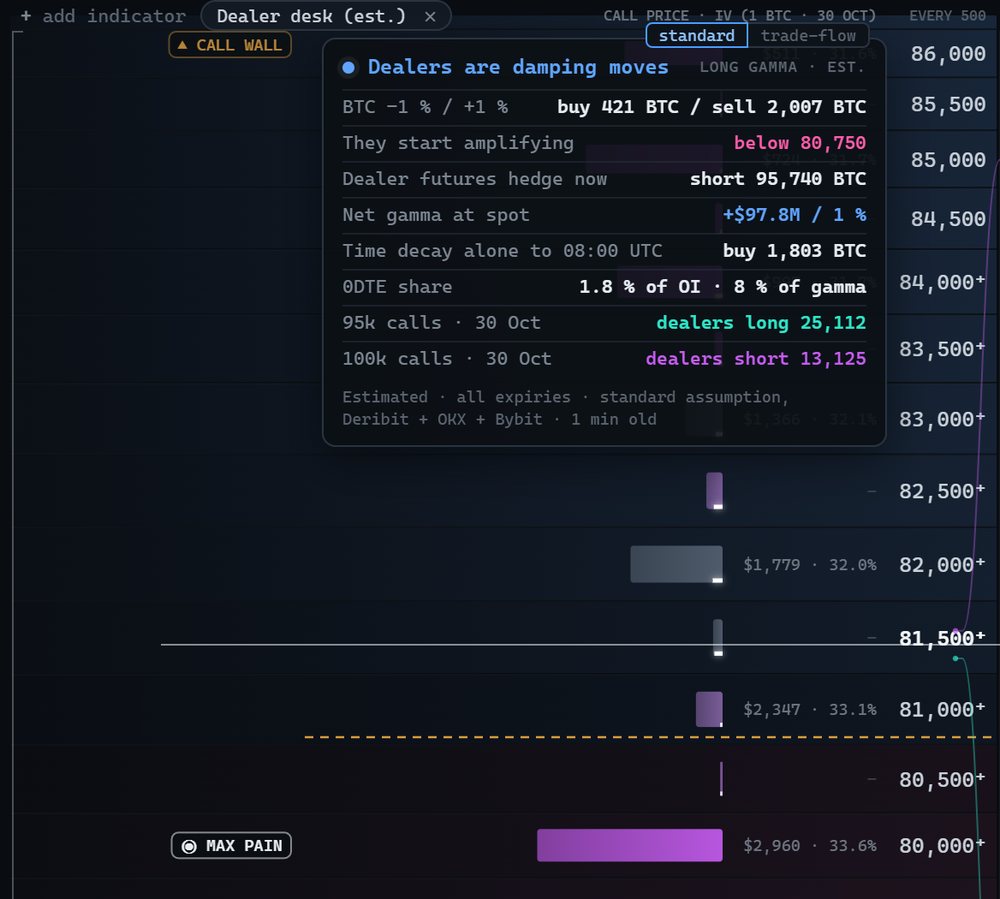
Turn on Dealer desk (est.) under + add indicator in Swiftedge Options, or the GEX indicator in Swiftedge Depth. The card translates the model into plain numbers:
- BTC −1 % / +1 %: how many BTC dealers would buy or sell if price moved 1 % down or up.
- They start amplifying: the price beyond which the model says hedging switches from damping to amplifying, in other words the gamma flip.
- Dealer futures hedge now: the estimated total futures position dealers hold against their options.
- Net gamma at spot: the hedging need in dollars per 1 % move at the current price.
- Time decay alone to 08:00 UTC: how much hedging would change by the next settlement even if price stood still.
- 0DTE share: how much of open interest and of gamma comes from options expiring today.
The column of numbers next to the price (sell 78, buy 138 and so on in Depth) is the same estimate at each price level: what dealers would trade to stay hedged if price went there.
The 08:00 UTC settlement
Bitcoin options settle at 08:00 UTC every day. In the hours before, same-day options carry a lot of gamma very close to price, so the model can show large hedge changes from small moves, and the time-decay line can become large. After settlement those positions are gone and the picture resets. Desks rarely re-hedge all at once; they usually spread it over time.
What our own data shows
If dealers hedge as the model says, their trades should leave a footprint. We looked for it four ways, using about 9 months of Binance BTC perpetual data and 30 days of Deribit perpetual data, with the tests written down in advance:
- net aggressive futures buying and selling against the model's predicted hedge, in five-minute steps;
- futures volume;
- changes in the passive order book;
- resting liquidity at the call and put walls compared with other round numbers.
None showed a clear footprint. At most a few percent of the predicted hedge appeared as aggressive futures flow. Likely reasons: dealers hedge passively with limit orders, on other venues or instruments, in bands rather than continuously, or simply hold different positions than any model assumes. And the scale is modest: the estimated hedging need is typically in the order of 100 million dollars per 1 % move, against many billions a day of BTC futures volume.
Use it as a translation, not a forecast. The Dealer desk turns options positioning into the language of futures: who would need to buy or sell, how much, and where that changes. It does not tell you what will happen next.
See GEX on live data.In Swiftedge Depth, open + add indicator and choose GEX to draw the gamma bands, the flip, the call and put walls and the estimated dealer hedge on the live Bitcoin order book. Free, no sign-up.
Open Swiftedge DepthCommon questions
Are the dealer hedge numbers real trades?
No. They are model estimates of what dealers would need to do to stay hedged, based on open interest and an assumption about who holds the options. Dealer positions are not public.
What happens at the 08:00 UTC expiry?
BTC options on Deribit, OKX and Bybit settle at 08:00 UTC. Same-day options carry the most gamma near price, so the model can show very large hedge changes around settlement. Desks usually unwind gradually, so the model's numbers overstate what you would see in the market.
What is the difference between 'standard' and 'trade-flow' in the Dealer desk?
Standard uses the common assumption that dealers are long calls and short puts on all three venues. Trade-flow rebuilds dealer positions from Deribit trades (taker = customer, maker = dealer) and covers Deribit only.