Guide
Call wall and put wall: what they are and how they behave
The call wall and put wall are the two strikes where estimated dealer gamma is largest: the biggest for calls and the biggest for puts. They are often described as a ceiling and a floor. Here is how they are calculated, why they so often sit on round numbers, and what happened when we checked them against Bitcoin's price.
How the walls are found
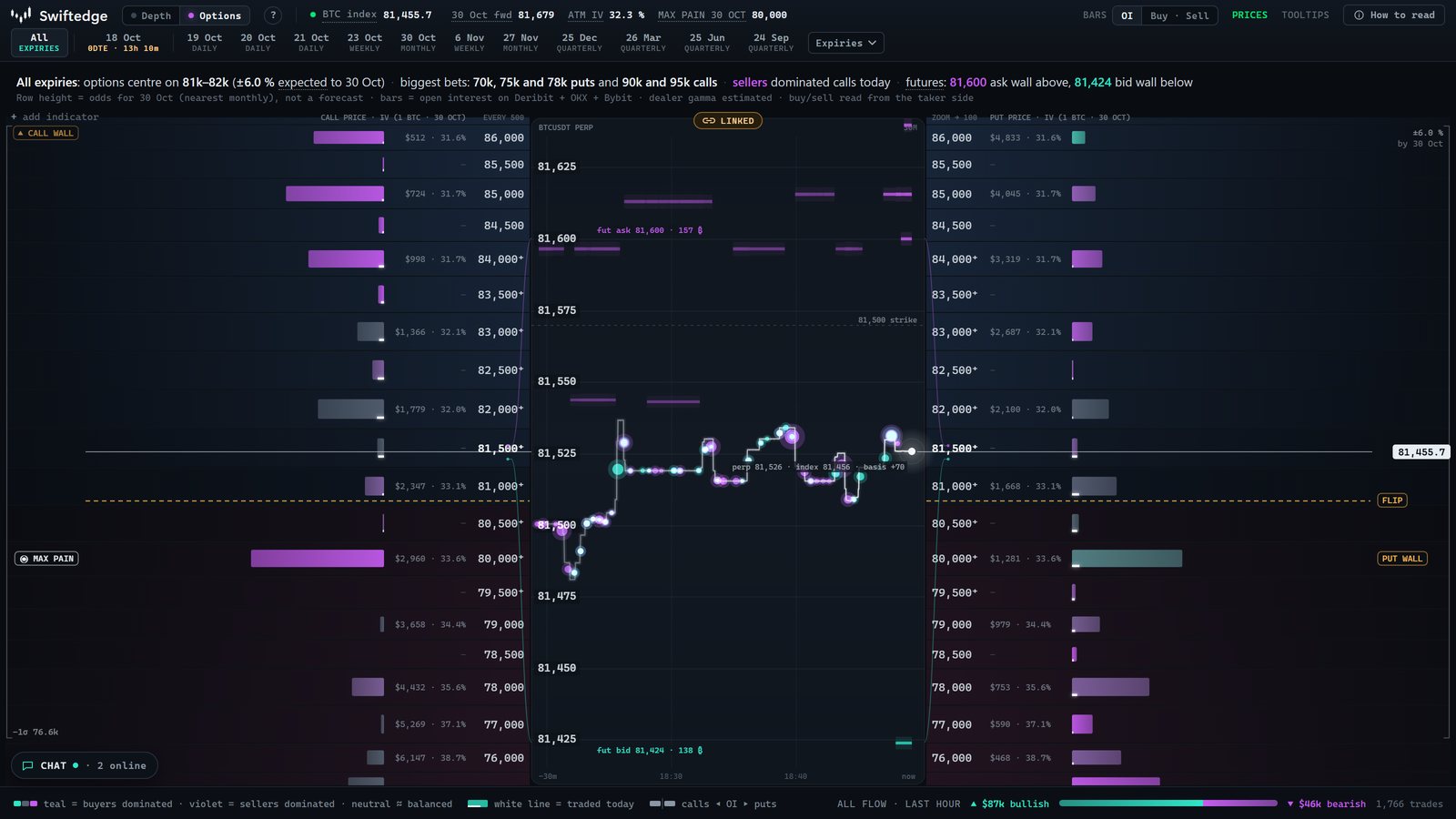
For each strike, Swiftedge adds up the estimated gamma of every open call and every open put on Deribit, OKX and Bybit, weighted by open interest. The call wall is the strike with the most call gamma and the put wall the strike with the most put gamma. Depth marks them CW and PW, separately for the same-day expiry and for later expiries, and Swiftedge Options tags them on the chain for the selected expiry.
Why traders watch them
The theory goes like this. Near a large call position, dealers who are long those calls hedge by selling into rallies and buying dips around that strike, which could slow price down there, hence "ceiling". The put wall is often called a floor, but under the same standard assumption dealers are short those puts, which would make their hedging lean with a move rather than against it. Either way the story depends entirely on who holds the options. Open interest is measured; positioning is not.
The walls also sit where a lot of attention sits anyway: big round numbers where many traders place orders, alerts and stops. That makes it hard to tell an options effect from a round-number effect.
What our own data shows
We rebuilt GEX levels every five minutes from about 3 million Deribit option trades from late December 2025 to October 2026, checked the rebuilt levels against real open interest, and then asked one question: does price respect the walls?
- Price broke through the GEX walls more often than through random levels at the same distance from price.
- A simple test of trading back toward the middle when price reached a wall, in the regime where dealers were estimated to be long gamma, lost money after costs over nine months, and did worse than all 20 sets of random levels we compared it with.
- Resting futures liquidity at the call wall was no larger than at other round numbers.
This does not mean the walls are meaningless. It means that, for Bitcoin, they work better as a description of where options positions are concentrated than as levels price is pushed away from.
Two kinds of wall. An options wall is a strike with a lot of estimated gamma. A liquidity wall is real resting size in the order book, visible in Swiftedge Depth. When both sit at the same price, that is worth noticing; when only the options wall is there, the book may be thin.
See the levels on the live chain.Swiftedge Options tags the call wall, put wall, gamma flip and max pain on the BTC options chain from Deribit, OKX and Bybit. Free, no sign-up.
Open Swiftedge OptionsCommon questions
Are the call wall and put wall real orders?
No. They are strikes where estimated option gamma is largest. Nothing is resting in an order book there. The glowing walls on the futures spine in Swiftedge Options are different: those are real resting futures orders.
Why are the walls usually at round numbers?
Because that is where options are listed and traded most: strikes like 80,000 or 90,000 attract far more open interest than the strikes between them.
Does price bounce off the call wall or put wall?
Sometimes, like it does off many levels. In our nine-month test, price broke through the GEX walls more often than through random levels at the same distance, so we do not treat them as reliable floors or ceilings.